Malachi of Hildesheim
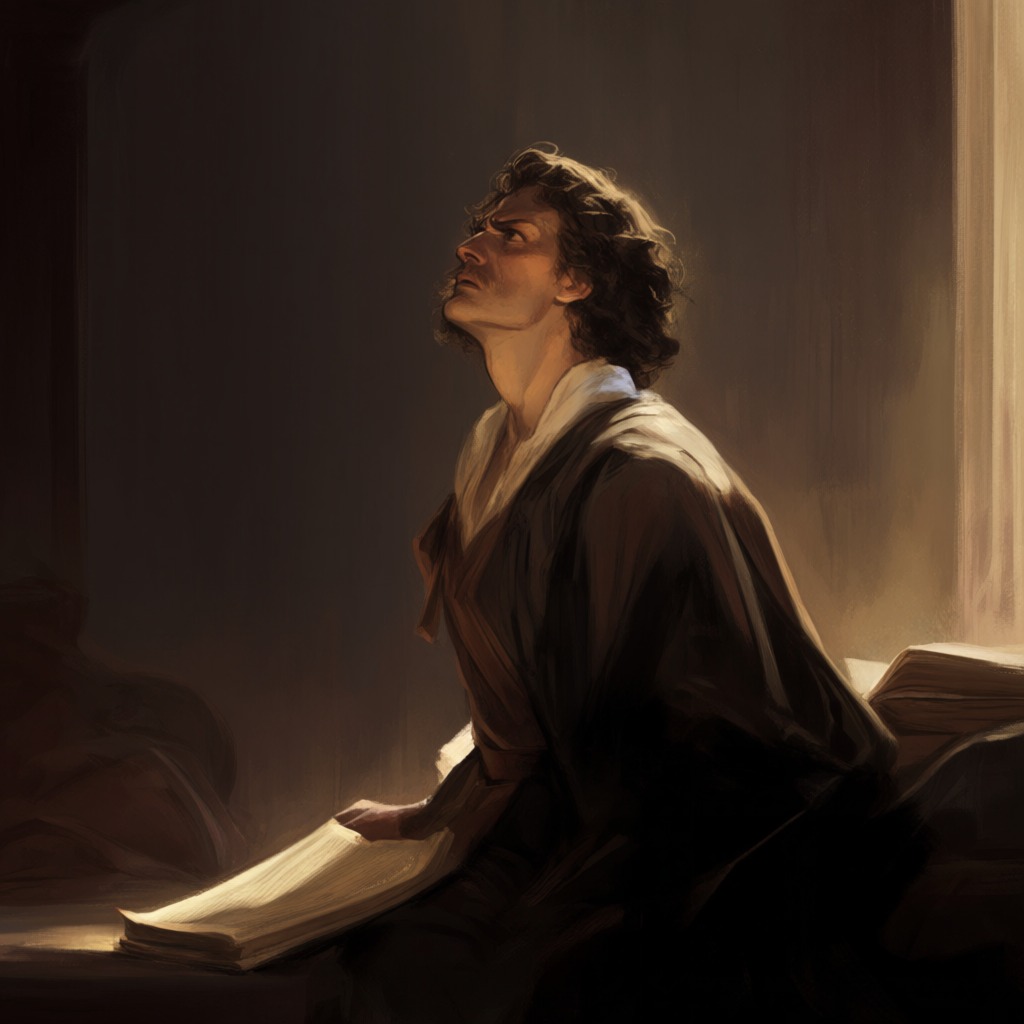
Malachi of Hildesheim, the librarian of the abbey, is a figure of austere and unsettling presence. Tall and extremely thin, with large, awkward limbs and a pallid face shadowed by his hood, he possesses a physiognomy marked by traces of disciplined passions that have frozen his features into an expression of sadness and severity. His eyes are so intense that they seem to penetrate the heart of anyone who meets his gaze, making it difficult to tolerate their inquiry. This physical description, given by Adso upon their first meeting, establishes Malachi as a man of formidable and intimidating authority, the living embodiment of the library's impenetrable mysteries.
Role and Authority as Librarian
Malachi's authority is absolute within the library, the top floor of the Aedificium. He alone, along with his assistant, knows the secret plan of the labyrinth and the collocation of every book. He explains to William that the library was laid out on a plan that has remained obscure to all over the centuries, and that only the librarian receives the secret from his predecessor, communicating it to the assistant librarian while still alive so that death will not rob the community of that knowledge. This secret seals the lips of both men. Malachi is responsible for deciding when and whether to give a requested volume to a monk, sometimes first consulting the abbot, because not all truths are for all ears. He keeps the catalogue of books, a voluminous codex fixed by a little gold chain to his own desk, and he alone can decipher the annotations that indicate a book's location. His control extends to the physical security of the Aedificium; he personally locks the outside doors of the kitchen and refectory after compline, barring them on the inside, and he emerges from a hidden passage through the ossarium to attend the night offices.
Relationships and Conflicts
Malachi's relationships with the other monks are marked by tension and suspicion. He is the master of Berengar of Arundel, his assistant librarian, but their bond is strained by Berengar's illicit relationship with Adelmo of Otranto and by Berengar's indiscreet references to the library's secrets, such as the "finis Africae." During the scriptorium debate on laughter, Malachi is present and, when Berengar begins to laugh inappropriately, he becomes furious, takes Berengar by the cowl, and sends him off to his tasks. This act reveals Malachi's role as a disciplinarian and his anxiety about any breach of the library's decorum. He is also deeply connected to Jorge of Burgos, the blind, elderly monk who serves as the library's memory and the soul of the scriptorium. Nicholas of Morimondo later reveals that, although the abbot is Malachi's confessor, Jorge rules his body, his actions, and his work. If anyone wanted to know the location of an ancient, forgotten book, they did not ask Malachi, but Jorge. This subordination to Jorge suggests that Malachi, despite his official power, is a tool of a more formidable will.
Key Actions and Objectives
Malachi's primary objective is to protect the library and its secrets, a mission that drives him to desperate acts. When he learns from Jorge that a forbidden book from the finis Africae has been stolen and is in Severinus's infirmary, he goes there, kills Severinus with an armillary sphere, and then ransacks the laboratory in a frantic search for the volume. He is discovered by the cellarer, Remigio, who has also come looking for the book, and Malachi is later confronted by Remigio, who desperately implores him, "You swear, and I swear!" Malachi responds, "I will do nothing to harm you," a promise that reveals a prior complicity between them. Malachi had previously hidden Dolcino's letters for Remigio, a secret that Bernard Gui exploits to destroy the cellarer. After recovering the book, Malachi returns it to the finis Africae, but his own curiosity or Jorge's command leads him to open it. He dies during matins on the sixth day, slumped forward in his stall, his tongue black and his fingers stained, having ingested the poison that had killed Venantius and Berengar. His last words are, "He told me ... truly. ... It had the power of a thousand scorpions," a direct reference to Jorge's warning about the book.
Change and Ending
Malachi's trajectory is one of a guardian who becomes a murderer and then a victim. He begins as the stern, seemingly incorruptible keeper of the library's order, but his loyalty to Jorge and his own desperate need to control the forbidden knowledge lead him to commit a violent murder. His death is a direct consequence of his own actions and his obedience to Jorge. He is not a mastermind but a tragic figure, a man who, in trying to protect a secret he did not fully understand, is consumed by it. His death, like those of the other monks, is a result of the poisonous book and the fanatical will of Jorge, who used Malachi as his instrument. The abbot's subsequent refusal to initiate Benno into the library's secrets, and the Italian monks' resentment of foreign librarians, highlight how Malachi's tenure was part of a long-standing conflict over the abbey's governance, a conflict that his death does not resolve but only intensifies.
Narrative Role and Evaluation
Malachi functions as a red herring and a key piece of the puzzle. His secretive behavior, his control over the library, and his evident distress make him a prime suspect in the murders. However, William's investigation reveals that Malachi is not the primary architect of the crimes but a subordinate agent of Jorge. His death provides crucial evidence—the blackened fingers and tongue—that confirms the method of poisoning and points toward the forbidden book. Malachi's character embodies the dangers of absolute secrecy and the corruption that can arise when knowledge is hoarded rather than shared. He is a cautionary figure, demonstrating how a monk's devotion to his duty can be twisted into a lethal obsession, and how the very institution meant to preserve wisdom can become a tomb for both books and men.